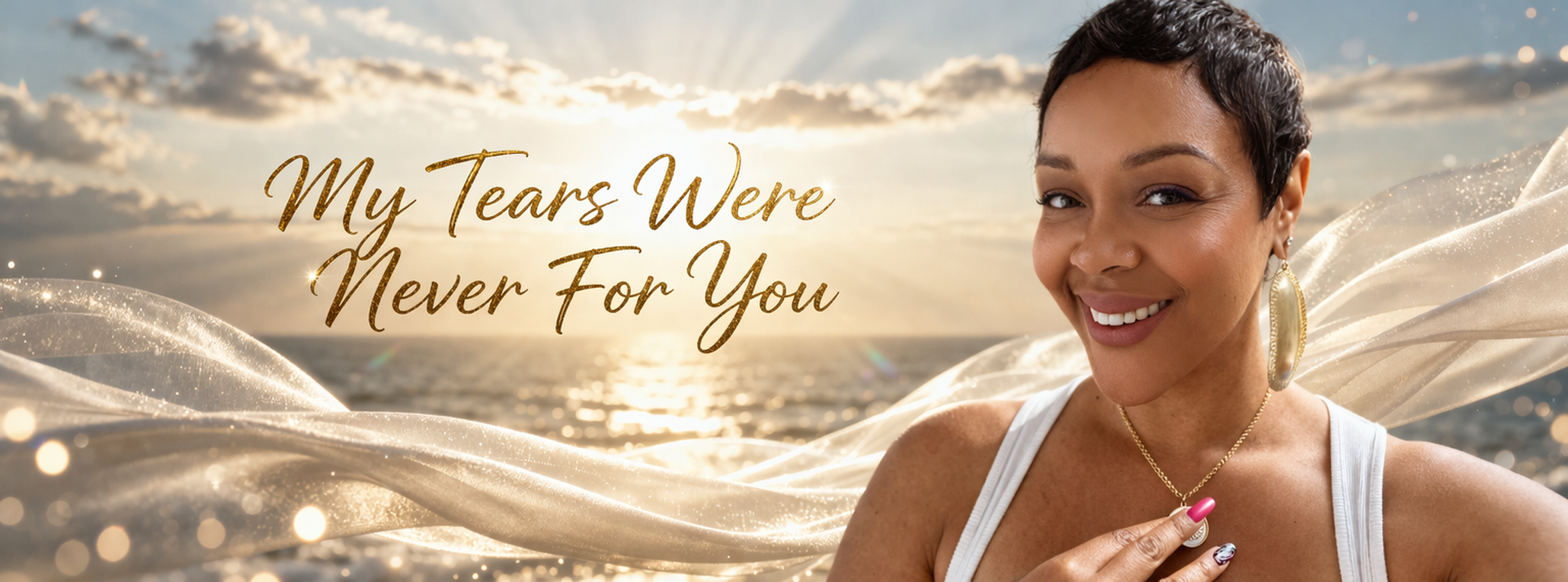
My Tears Were Never For You
On grief, privacy, and why I have never cried on camera.
By Kinyatta E. Gray | Honoring Miss Bee | Grief Educator | Author
Eight years.
Eight years of publicly sharing my grief journey. Eight years of blog posts, podcast episodes, social media content, videos, and written reflections about losing my mother, the late Beverly E. Carroll, my Miss Bee.
And not once. Not a single time. Have I cried on camera for the world to see.
I want to talk about that today. Not to explain myself, I do not owe anyone an explanation for how I choose to grieve. But because I think there are women out there who grieve the same way I do, privately and fiercely and behind closed doors, who have been made to feel like their grief is somehow less valid because it does not perform for an audience.
This one is for them.
I do not owe my tears to anyone. Not to my followers. Not to my community. Not to the algorithm. Not to the world.
Let Me Be Honest About What I Believe
People do not care about your tears. Not the way you need them to. Not the way it costs you to produce them.
I know that is a hard thing to read. But I have watched enough grief content over eight years to know that what grief tears on social media generate more often than genuine care and compassion — is entertainment. Curiosity. The uncomfortable but very human impulse to watch someone else's pain from a safe distance.
People scroll past devastation the same way they scroll past everything else. A thumb moving across a screen does not know the difference between someone's worst moment and a recipe for banana bread. Both receive the same gesture. Both disappear in the same two seconds.
I knew this instinctively from the beginning. And I made a decision — a quiet, private, unannounced decision — that my tears would never be content. That my grief would not become someone else's viewing experience. That the most sacred and devastating parts of losing my mother would belong to me and to me alone.
My grief would not become someone else's viewing experience. The most sacred parts of losing my mother belong to me.
Did I Cry? Let Me Tell You About Crying.
Every single day. For months. In places where no camera could follow me.
After my spouse left for work and the house went quiet and the silence had her absence in it — I cried there.
Before I went to sleep when the dark gave me permission to stop performing okayness — I cried there.
In my car. Every time. The car became its own kind of confessional — the one space where I could fall completely apart without consequence, without witness, without anyone needing me to pull it together for their comfort.
And I still cry. Eight years later. The grief does not end. It transforms.
It is not the acute cry anymore — the one that feels like drowning, the one that arrived in the first months and had no bottom to it. It is something different now. Quieter. More specific. More devastating in its precision.
I cry when the sun hits my face a certain way and I feel, without explanation, that it is her.
I cry when I look at my grandson — this beautiful boy she wanted so desperately to meet — who came into the world four months after she left it. She wanted to see that baby so badly. She talked about him before she knew who he would be. And when I look at his face I see everything she missed and I feel that absence in my chest like a physical weight.
When I cry — and I want to be specific about this because it matters — it is not a photogenic cry. It is not the kind of cry that looks like grief on a screen. It is ugly. It is gasping. It is the kind of cry where you cannot catch your breath and your whole body is involved and you are not sure for a moment if you will find your way back from it.
That cry is mine. It belongs to me and to Miss Bee and to the love between us that did not end when she did.
It was never available for consumption.
When I cry it is ugly. It is gasping. It is the kind that has no bottom. That cry is mine. It was never available for consumption.
I Do Not Judge Those Who Grieve Publicly
I want to be completely clear about this because I mean it entirely.
If you have cried on camera. If sharing your grief publicly has been your way of processing it, of feeling less alone, of building a community around the most painful experience of your life — I do not judge you for that. Not even slightly.
Grief is the most personal human experience there is. There is no correct way to do it. There is no format it is required to take. Some people need to be witnessed in their pain. Some people need to speak it out loud to make it real. Some people need to know that someone is watching and that they are not completely alone in it.
That is real. That is valid. That is a legitimate form of grieving.
What I am saying is that it is not my form. And for a long time I wondered if there was something wrong with me — if my privacy was really just avoidance, if my silence was really just suppression, if the fact that I never broke down publicly meant I was not grieving deeply enough.
Eight years have taught me that the opposite is true. The depth of private grief is not less than the depth of public grief. It is just private. And privacy is not the same thing as absence.
The depth of private grief is not less than the depth of public grief. It is just private. And privacy is not the same thing as absence.
What Engagement Actually Is
I have consistent followers. People who have been with me for years. People who engage — who comment, who share, who message, who tell me that something I wrote changed something for them.
I am grateful for every single one of them. Genuinely.
And I am also clear-eyed about what engagement is and what it is not.
Engagement is not care. Not automatically. Not inherently. Engagement is attention — and attention is a complicated and impermanent thing. The same person who comments on your most devastating post will scroll past it tomorrow without remembering it. The algorithm that surfaced your grief to a thousand people has no idea what it cost you to produce it.
I have never been foolish enough to mistake consistent engagement for genuine relationship. I have never assumed that because someone has followed my journey for three years they are invested in my wellbeing the way a person who actually knows me would be.
That is not cynicism. That is clarity. And that clarity has protected me.
It has kept me from handing my most sacred grief to an audience that — through no fault of their own — was not equipped to hold it. It has kept the most private parts of my loss exactly where they belong. With me. With Miss Bee. Between us.
Engagement is attention. And attention is a complicated and impermanent thing. I was never foolish enough to mistake one for the other.
What It Cost To Get Here
I want to say something that I do not say often enough.
It cost everything to get to a week without crying. To a day where the grief does not ambush me before I have had my coffee. To a morning where I wake up and feel something close to okay before the remembering arrives.
I worked for this. Not in the sense that grief is a project to be completed — it is not. But in the sense that continuing to live, continuing to build, continuing to show up for my work and my products and my community and my grandson and my own becoming — while carrying the absence of the person who was the center of my world — required a level of effort that I do not think the people watching my content have ever fully understood.
Because they could not see the cost. Because I did not show it to them.
Some days I am proud of that. Some days I wonder if I did myself a disservice — if the privacy that protected me also isolated me in ways that compounded the grief rather than relieving it.
But then I think about who would have held it if I had handed it over. And I think about the scroll. And I think about the two seconds. And I think about my Miss Bee deserving better than that.
And I know I made the right decision.
At This Part Of My Journey
I am eight years out. I am in what I call later grief — the season that comes after the acute pain has shifted into something more livable, more navigable, more integrated into the fabric of who I am becoming.
At this part of my journey I do not consume trauma-based grief content. I cannot. Not because I do not have compassion for the women who are in the acute season — I do, deeply and completely. When I encounter that content I whisper a silent prayer to the heavens for them and I bow out. Because it took too much to get here. It took too much to reach a place where the grief no longer has the power to level me every single day. And I protect that place.
I am not past grief. I will never be past grief. Miss Bee was my mother, my best friend, my sister in spirit, my fiercest protector, and the only person on this earth who loved me without condition or complication. That loss does not have a finish line.
But I am in a different country now than I was in 2018. The landscape is different. The air is different. And the version of me that inhabits this country does not have the same relationship with grief content that she once did.
She tends to herself instead. Quietly. Privately. With bath soaks and affirmation cards and chamomile tea and the particular kind of cry that happens in the car when a song comes on that Miss Bee would have loved.
She builds things in her mother's name. She writes. She creates. She keeps going.
She just does not do it on camera.
To the woman reading this who has also never cried on camera —
your grief is not less because it is not visible.
Your tears are not less real because they fell in private.
Your love is not less profound because no one witnessed it breaking you.
You do not owe anyone your pain.
Not even the people who have been watching you for years.
About The Author
Kinyatta E. Gray is a Certified Master Life Coach, bestselling author, grief educator, and 2023 Remarkable Women Award winner. She is the founder of Honoring Miss Bee, a grief healing brand created after losing her mother, the late Beverly E. Carroll, in 2018. She writes about grief the way it actually is -- without clinical jargon, without platitudes, and without rushing anyone through the most human experience there is. She believes deeply that grief deserves better language, and that every motherless daughter deserves a space that sees her exactly where she is.
honoringmissbee.org | Etsy: HonoringMissBee | Podcast: Grieving Unapologetically
If this resonated share it with a woman who grieves privately.
She needs to know she is not alone in her silence.