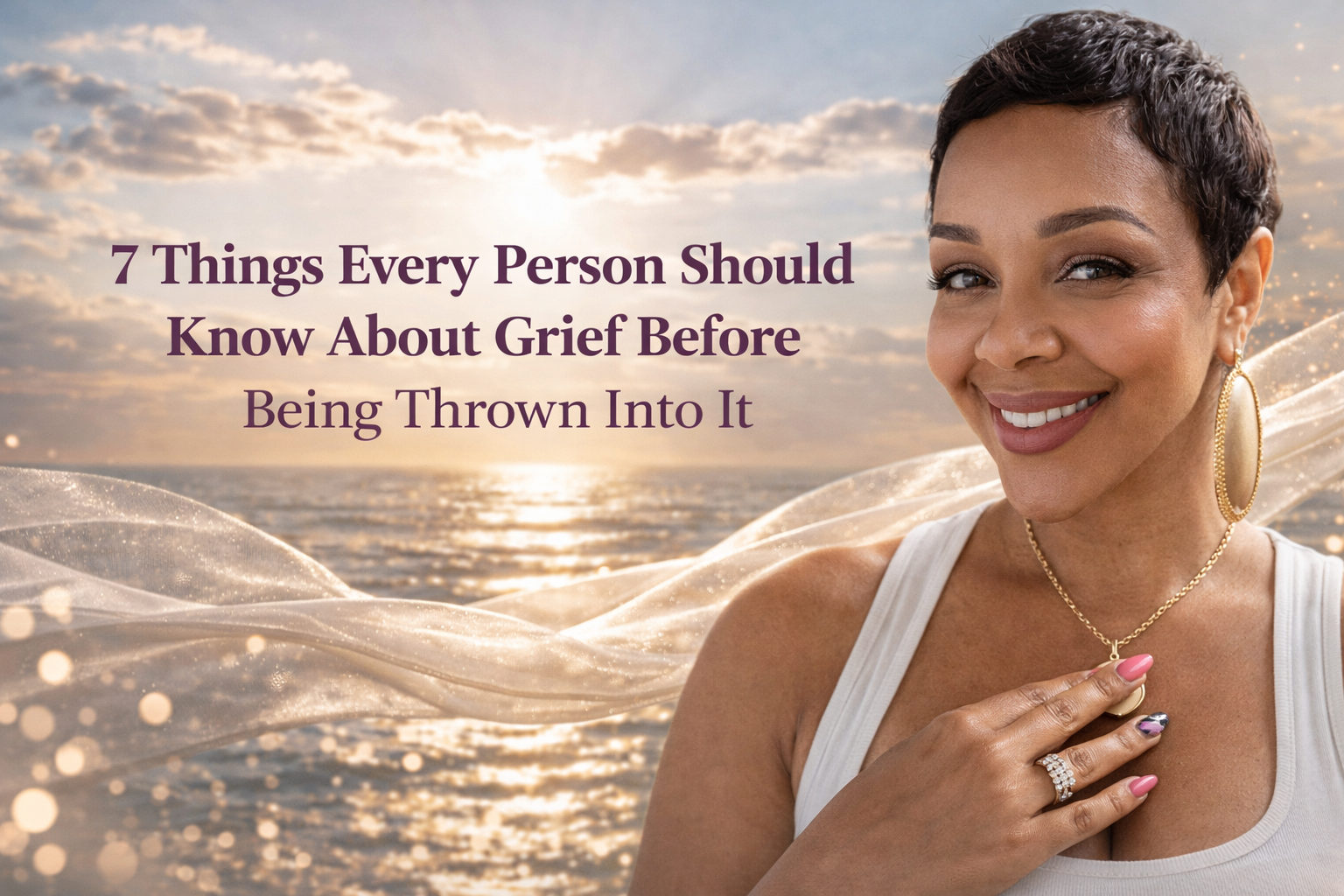
7 Things Everyone Should Know About Grief Before Being Thrown Into It
Imagine learning to drive for the very first time.
Not in a parking lot on a Sunday morning. Not with an instructor in the passenger seat. Not with months of lessons building slowly toward the moment you are ready.
Imagine that the first time you ever sat behind the wheel, someone handed you the keys and said — urgently, without explanation — drive. There is somewhere you need to be. You have no choice. Go.
That is exactly what grief is.
That is exactly what it was for me.
I did not know what grief was until it became the only language I knew — and by then I was already in the deepest throws of it, learning the vocabulary while drowning in the experience.
I was one of the people who thought grief was a one-time event. Something that happened at funerals. Something you felt, moved through, and filed away in the permanent folder of hard things that had passed.
I had never even said the word grief in reference to my own life — despite the fact that I had been experiencing it for years. In the friendships that quietly dissolved. In the career I walked away from. In the versions of myself I had to leave behind when life pivoted without asking my permission.
Nobody told me that was grief. So I called it something else and kept moving.
And then my mother died.
October 21 2018. The day my life changed as I once knew it, leaving me to embrace a new perspective on earth, alone.
It was not until I sat in a therapist's office after the funeral that someone finally handed me the language for what I was experiencing. And I remember feeling two things simultaneously — profound relief that there was a name for it, and profound rage that no one had given me that name before I needed it most.
We do not prepare people for grief. We simply do not. And that is one of the greatest disservices our culture perpetuates — because grief is not an if. It is a when. For every single one of us.
So consider this my attempt to hand you the keys before you need them.
7 Things Everyone Should Know About Grief Before Being Thrown Into It
Grief Is Not Just For Funerals
I was in my forties before I ever used the word grief in reference to my own life.
I had ended friendships that shaped who I was. I had walked away from a career that gave me identity and income. I had survived the slow dissolution of relationships that I thought were permanent. And through every single one of those experiences I called what I felt by every name except the right one.
Sad. Disappointed. Hurt. Moving on.
No one told me that was grief. No one handed me the language for what I was carrying. And because I had no framework for it I had no way to process it — so it accumulated. Quietly. In layers. Until the loss that finally named itself arrived.
Grief is the natural response to any significant loss — the end of a relationship, a career transition, a change in identity, a friendship that quietly disappears, a version of yourself that no longer exists. It does not require a death certificate to be real.
The world teaches us that grief belongs at funerals — that it is a specific, time-limited response to death. That is one of the most dangerous myths we carry. Because when we do not recognize our smaller griefs for what they are we arrive at our largest grief completely unprepared and carrying everything we never processed along the way.
✦ REMEMBER THIS:
You have probably been grieving longer than you know. The loss that broke you open was not your first encounter with grief — it was just the one that finally taught you its name.
Grief Does Not Follow A Timeline — And The World's Does Not Match Yours
Somewhere along the way someone decided that grief had stages. Five of them. Neat. Sequential. Completable.
I went to therapy after my mother died and I learned something that no one had ever told me before — grief is not linear. It does not move from denial to acceptance in an orderly progression. It ambushes you. It circles back. It arrives without warning six months, six years, sixteen years after the loss — in a grocery store aisle when a familiar perfume drifts past, in the car when a song comes on that she would have loved, on a Tuesday morning with no particular reason.
And the world around you — your workplace, your friends, your family — has a completely different timeline for your grief than your body does. The casseroles stop coming after two weeks. The check-ins thin out after a month. By the third month most people have returned to their lives and quietly expect you to have returned to yours.
You have not. You will not. Not on their schedule.
One of the most isolating experiences of grief is realizing that the world's timeline and your timeline have almost nothing in common — and that you will be expected to perform recovery long before it has actually arrived.
✦ REMEMBER THIS:
Grief is not a problem to be solved on someone else's schedule. It is a love that has nowhere left to go — and it moves at its own pace, on its own terms, for as long as it needs to.
The Support System Will Disappear — And You Need To Know That Before It Does
No one warned me about this part.
In the immediate aftermath of loss people show up. Flowers arrive. Food appears. Messages flood in. For a brief, disorienting window the world gathers around your grief and you feel — despite everything — held.
And then it stops.
Not maliciously. Not because the people who showed up did not care. But because life continues for everyone who is not the one grieving. And a world that was never taught how to sit with someone else's pain for an extended period of time eventually returns to what it knows — which is moving forward.
Research consistently shows that support from friends and family tapers off within three months of a loss. Three months. When grief is just beginning to settle into its true shape — the quiet, daily, pervasive kind that does not announce itself — the people who were present for the acute phase have largely moved on.
I learned this the hard way. I was not prepared for the silence that followed the noise. I was not prepared to grieve largely alone. And the isolation of that — of discovering that the grief journey is mostly a solitary one — was its own separate loss that I had to grieve too.
If I had known this before I lost my mother I would have built my support infrastructure differently. I would have found my grief community earlier. I would have known that the quiet was coming and prepared for it rather than being leveled by it.
✦ REMEMBER THIS:
The people who show up at the funeral are not always the people who will show up at month six. Build your grief community before you need it — because by the time you need it you will not have the energy to build it from scratch.
Your Identity Will Change — And That Is Not A Betrayal
I did not know I would become a different person.
I knew I would be sad. I knew I would miss her every day. I knew that certain holidays would be impossible and certain ordinary Tuesdays would be unexpectedly devastating. I knew the practical things.
What I did not know was that grief would reach inside me and rearrange the furniture. That the woman who existed before October 21 2018 would not be the same woman who existed after it. That some of what I lost with my mother was not just her presence but the version of myself that only existed in relationship to her — the daughter who was seen, who was celebrated, who had someone who knew her whole story.
Grief changes your identity. It changes what matters to you and what does not. It changes how you move through the world, what you tolerate, who you keep close, what you spend your energy on. It changes your relationship to time and to joy and to other people's ordinary complaints about their mothers.
I have cut off people who could not show up for me in my grief. Not bitterly — but clearly. Because grief taught me something about who I am and what I need that I had not known before. And I am not the same woman I was before. I am something more complex. More layered. More clear-eyed.
That is not a betrayal of who I was. That is what becoming looks like after profound loss.
✦ REMEMBER THIS:
Grief will change you. Not break you — change you. The woman on the other side of it is not lesser than the one who went in. She is more. More knowing. More clear. More fiercely herself.5
Grief Lives In Your Body — Not Just Your Mind
No one told me grief was physical.
I thought it would live in my thoughts — in memories and missing and the particular ache of reaching for the phone before remembering. And it does live there. But it also lives in the body in ways I was completely unprepared for.
The exhaustion that has no bottom. The weight in the chest that arrives without warning. The way certain smells bypass the mind entirely and land directly in the nervous system. The appetite that disappears or the appetite that cannot be satisfied. The sleep that will not come or the sleep that will not release you. The physical sensation of absence — which sounds like a contradiction but is absolutely real to anyone who has felt it.
Grief is a full body experience. And a world that treats it as an emotional or psychological event — something to be talked through, therapized out of, processed with words — misses the profound somatic dimension of what loss actually does to a human being.
This is why tending matters. Not as a luxury. As a necessity. The bath ritual, the foot soak, the intentional moment of physical care — these are not indulgences. They are responses to a physical reality that grief creates in the body. The body that carried the love also carries the loss. It deserves the same tending that the mind and heart receive.
I learned this slowly. I wish someone had told me before I spent months wondering why I was so tired when I had not done anything.
✦ REMEMBER THIS:
Your body is grieving too. The exhaustion is real. The physical ache is real. Tending to your body after loss is not self-indulgence — it is one of the most honest and necessary things you can do for yourself.
Good Days Are Not A Betrayal — And Joy Is Not Forgetting
The first time I laughed — really laughed — after my mother died I felt guilty for days.
No one prepared me for the grief that comes with having a good day. The specific, complicated guilt of realizing you went an entire afternoon without crying. The feeling that joy is somehow a betrayal of the person you lost — as if your happiness diminishes their memory or signals that you have moved on when you absolutely have not.
I had to learn — slowly, imperfectly, with help — that joy and grief are not opposites. That you can hold them simultaneously. That laughter does not mean forgetting. That a good day does not erase the loss. That your mother — or whoever you lost — is not diminished by your willingness to still find things worth smiling about.
The world does not prepare you for this either. The world tends to reward visible grief — the tears, the withdrawal, the obvious signs of suffering. Invisible grief — the functional grief, the quiet grief, the grief that happens in private — is not recognized as grief at all. And so when you have a good day and someone says you seem better you are left explaining that better is not the same as over.
Your mother raised you for life. Not for a lifetime of mourning. Joy in your continued living is not a departure from her memory. It is, in the most profound sense, the fullest possible honoring of it.
I had to learn that. I am still learning it. But I wish someone had told me before I spent months punishing myself for surviving.
✦ REMEMBER THIS:
You are allowed to have a good day. You are allowed to laugh. You are allowed to want things and feel joy and continue becoming. That is not forgetting. That is living — which is the only tribute that truly honors the person who wanted you here.
Grief Is A Lifelong Companion — Not A Season To Survive
The most dangerous thing anyone ever told me about grief — without saying it directly — is that it ends.
Eight years after losing my mother I still cry in the car. I still reach for my phone before I remember. I still feel her absence at every significant moment — the award I won that she never got to frame, the grandson she died four months before meeting, the products I built in her name that she will never hold in her hands.
Grief does not end. It changes. It evolves. It becomes less consuming and more integrated — woven into the fabric of who you are rather than a wave that drowns you. But it does not disappear. And anyone who tells you it does is describing a grief they have not yet fully met.
What changes is your relationship to it. In the early months grief is the loudest thing in the room. It demands everything. It leaves no space for anything else. Over time — with tending, with community, with the slow and non-linear work of becoming — grief finds its place alongside the rest of your life rather than consuming it entirely.
I am not over my mother's death. I will never be over it. But I have built a life that holds both the loss and the living — that makes space for the grief and the joy and the becoming all at once.
That is not the end of grief. That is what it looks like when grief becomes something you carry rather than something that carries you.
And that distinction — between being carried by grief and learning to carry it — is the whole journey.
✦ REMEMBER THIS:
Grief does not end. It becomes a companion rather than a captor. The goal is not to be over it — the goal is to be in a relationship with it that allows you to also be in a relationship with your life.
Nobody Was Going To Hand You The Manual
I spent the first year after losing my mother learning everything I should have known before she died.
I learned that grief is not a season but a companion. That it lives in the body as much as the mind. That the support system disappears far sooner than the grief does. That joy is not a betrayal. That the identity I had before her death would not be the identity I carried forward — and that the new one, though heavier, would also be more clear-eyed and more fully mine.
I learned all of this while in the most acute pain of my life. While drowning. While trying to drive a car I had never been taught to operate.
And then I built Honoring Miss Bee. Not because I had healed. But because I refused to let another woman learn what I learned the way I learned it — alone, unprepared, and in the deep end.
We simply do not function in a world that prepares us for grief. And that is a disservice of the highest order — because grief is not optional. It is the price of love. And every single one of us will pay it.
If you are reading this before your great loss arrives — save it. Share it. Talk about it with someone you love. Normalize the conversation before you need it to be normal.
If you are reading this in the middle of your loss — I see you. You are not behind. You are not doing it wrong. You are simply learning to drive while the car is already moving. That is not a failure. That is the human condition.
And if you are reading this years out — in the quiet season of becoming — then you already know everything on this list in your bones. You lived it. And you are still here. Still tending. Still becoming.
That is not nothing.
That is everything.
About The Author
Kinyatta E. Gray is a bestselling author, grief educator, and 2023 Remarkable Women Award winner. She is the founder of Honoring Miss Bee — a grief healing brand created after losing her mother, the late Beverly E. Carroll, in 2018. Through her writing, podcast, music, products, and community, Kinyatta speaks to the realities of mother loss with honesty, compassion, and zero clinical jargon. She believes grief deserves better language — and that every woman navigating loss deserves to be met exactly where she is.
honoringmissbee.org | Etsy: HonoringMissBee | Podcast: Grieving Unapologetically | Music: Music In Stilettos
If this landed somewhere true for you —
share it with someone who needs the keys before they need to drive.